Now Reading: Apple Teleport and the Future of Instant Transportation
-
01
Apple Teleport and the Future of Instant Transportation

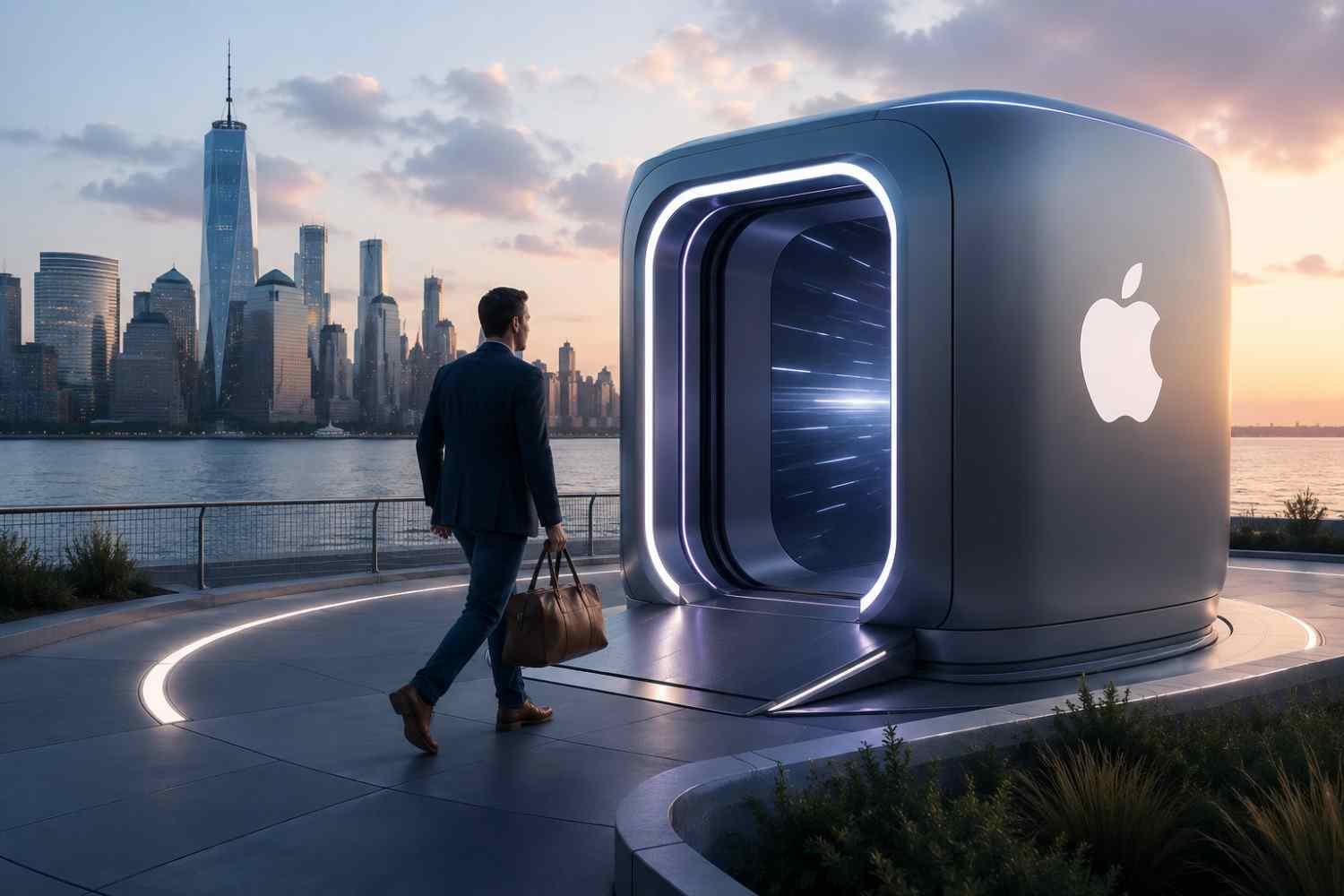
I first noticed the Apple Teleport idea while looking at advanced technology clips that can make a few seconds of scrolling feel like science fiction. The polished visuals, Apple-style design language, and promises of instant travel made the concept sound surprisingly plausible. Then the details started to feel less convincing.
I found the biggest clue in the claims surrounding it. There is no Apple teleportation machine carrying people between cities, and no credible evidence that Apple built a $29 million device for instant travel. What exists is a mixture of viral hoaxes, a real Vision Pro travel app, an Apple video-editing lesson, and genuine scientific research that uses teleportation in a different way.
What Apple Teleport Actually Is
Apple Teleport is not the name of a transportation product made by Apple. Viral posts have presented machines and demonstrations, but those images and videos do not establish that a working teleporter exists today.
The confusion is understandable. Apple has spent years building products that once sounded advanced, so sleek concept videos can look believable. AI visuals and social media editing make invented products even easier to accept.
The supposed $29 million Apple teleport machine falls into that category. There is no verified Apple announcement establishing such a device as a product or research project. Without technical evidence, a viral clip is not proof.
A Real App Adds to the Confusion
The App Store lists Teleport: Instant Transport, a travel application designed for Apple Vision Pro. It uses Google Maps Street View imagery to let users explore destinations and landmarks through an immersive interface. The user’s physical location does not change.
Virtual presence and physical transportation can look similar in a short demonstration. A headset can surround you with a detailed view of another location, making the experience feel immediate without changing your physical location.
Why Apple Has Used the Word Teleport
Apple has also used teleportation as a filmmaking concept in its education materials. One lesson teaches students to make someone appear to teleport by recording matching shots and joining them with a cut. It creates an illusion rather than moving the person.
Could a Machine Really Teleport a Person?
Human teleportation would require far more than moving a digital image. A physical body contains enormous amounts of information about its matter. A hypothetical system would need to describe, transmit, reconstruct, and verify that state with extraordinary precision.
Quantum mechanics does not provide a simple shortcut for transporting a person. Quantum teleportation transfers information about a quantum state between systems. It does not beam a complete object through space or provide a working method for transporting humans.
The engineering challenge also involves energy, measurement, error correction, reconstruction, and the original physical system.
Quantum Teleportation Is Real, But Different
The word teleportation is not fictional in modern physics. Researchers have demonstrated quantum teleportation, but what moves is quantum information rather than a person or ordinary object.
A Caltech-led team working with Fermilab demonstrated quantum teleportation across 44 kilometers of fiber, with fidelity above 90 percent. The experiment transferred quantum information using entanglement and advanced quantum networking, not instant transportation.
That distinction matters whenever a headline claims scientists have “achieved teleportation.” They may have achieved something remarkable, but the result can be radically different from the science-fiction meaning of the word.
What Apple Can Realistically Bring to Instant Transportation
Apple’s more relevant contribution is spatial computing. Apple Vision Pro can place digital content into a user’s physical environment, making virtual information feel anchored to the surrounding world. It does not transport the wearer, but it can change how distance feels.
This creates a believable path toward instant transportation. Imagine joining a remote event through spatial interfaces, exploring a distant location in immersive 3D, or interacting with a remote colleague as though they were nearby. None requires matter to disappear and reappear.
Remote presence could grow as cameras, displays, sensors, networks, and spatial interfaces improve. Travel will remain necessary, but some meetings, tours, events, and collaborations may become location-independent for everyday travelers in some situations too.
What the Future of Instant Transportation May Look Like
The future may be about reducing the practical importance of distance. Faster aircraft, autonomous vehicles, telecommunications, immersive computing, robotics, and remote presence can each attack a different part of the problem.
A person might not physically arrive somewhere instantly, yet technology could let them see it, communicate from it, control a machine there, or participate in an experience with remarkable immediacy. That is not the transporter imagined in movies, but it could still change travel.
For now, Apple Teleport is best viewed as an internet-era concept rather than a secret Apple breakthrough. Digital experiences can make distant places feel close, while physics still separates moving information from moving people.
FAQs: Apple Teleport and the Future of Instant Transportation
1. Is Apple Teleport real?
No. Apple has not announced or released a physical teleportation machine for transporting people or objects. Viral claims about an Apple teleport device are unsupported.
2. Is the $29 million Apple teleport machine real?
There is no verified evidence of a $29 million Apple teleportation machine. Viral videos should not be treated as proof of a real product.
3. What is Teleport: Instant Transport?
It is a third-party travel app for Apple Vision Pro that uses Google Maps Street View to provide immersive views of destinations. It does not physically transport users.
4. Can quantum teleportation transport humans?
No. Quantum teleportation transfers quantum information between systems. It does not currently provide a method for moving human bodies or ordinary physical objects.
Why Distance May Become Less Important
The fascination with Apple Teleport says something useful about technology. People want less friction between themselves and places, people, information, and experiences. Spatial computing, immersive mapping, remote presence, and quantum networking approach that desire differently.
A literal teleporter remains outside today’s technology, but the feeling behind the idea is already being engineered. As technology brings places into our surroundings, instant access may feel impossible.
The future may not let us teleport our bodies. It may simply make distance matter less.